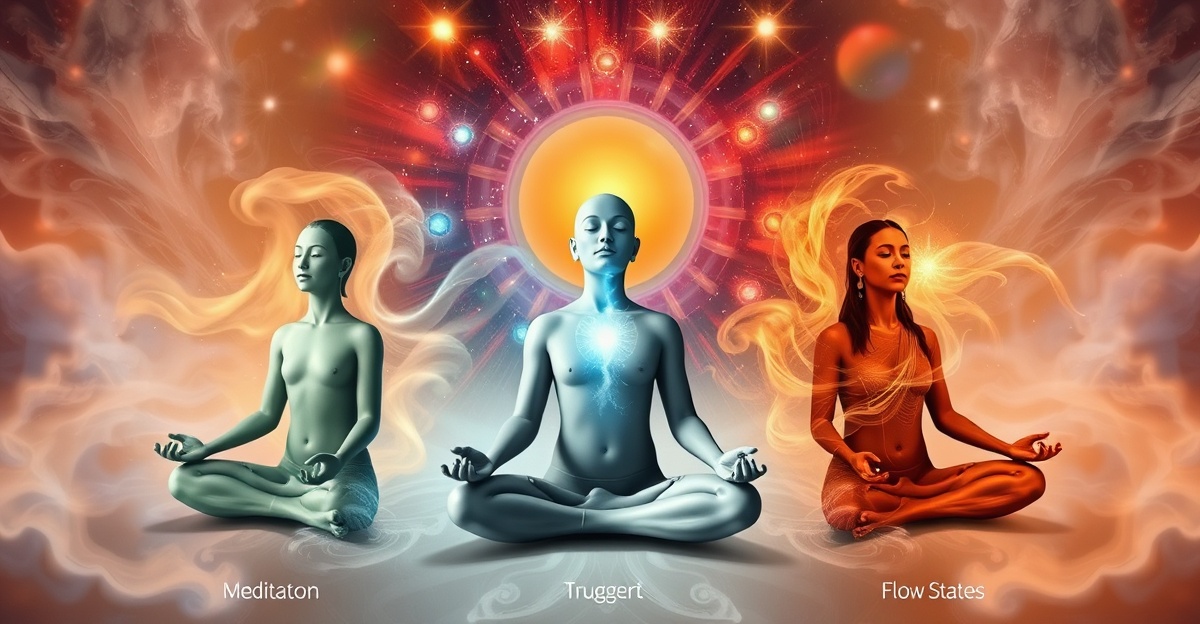
Beyond ordinary waking consciousness, there are many altered states that can facilitate healing: meditation, breathwork, flow states, trance states, movement-induced states, community-induced altered states.
These altered states can provide access to healing, insight, and transformation. They can also be destabilizing if not navigated carefully, especially for trauma survivors.
What Are Altered States?
Altered states of consciousness are any state different from ordinary waking awareness. They might involve:
- Heightened sensory awareness
- Changed perception of time
- Access to different parts of mind/consciousness
- Feelings of expansion, connection, or dissolution of boundaries
- Non-ordinary experiences (visions, insights, feelings of unity)
- Decreased ordinary thinking
- Changed sense of self
Different Altered States
Meditative states - Achieved through meditation, these involve decreased thinking and sensory focus. Deep meditation can feel like accessing the space beneath thought.
Flow states - Achieved through engaging activities where skill matches challenge. Time seems to disappear; you're fully immersed.
Breathwork-induced states - Conscious breathing patterns can alter consciousness, sometimes profoundly. Holotropic breathwork, Wim Hof breathing, and other techniques can facilitate altered states.
Trance states - Rhythmic movement, drumming, or music can induce trance. This is used in many shamanic and spiritual traditions.
Sound-based states - Gong baths, sound frequency therapy, or chanting can shift consciousness.
Movement-based states - Dance, ecstatic movement, or other movement can facilitate altered consciousness.
Group-induced states - Being in community with shared intention can amplify altered states (think concerts, religious gatherings, protest marches).
Why They Can Be Healing
Altered states can facilitate healing by:
Bypassing normal defenses - In altered states, your usual psychological defenses relax, allowing access to material that's normally protected.
Activating different neural networks - Altered states activate brain regions associated with insight, intuition, and non-ordinary knowing.
Creating neuroplasticity - These states increase the brain's capacity to form new connections and rewire patterns.
Accessing different levels of consciousness - You might access trauma that hasn't been processed by ordinary consciousness, or access wisdom beyond your ordinary mind.
Facilitating emotional release - Altered states often allow emotions to move and be released in ways they can't in ordinary consciousness.
Providing perspective - From an altered state, you might see your situation differently, gaining insight impossible from ordinary consciousness.
The Dangers to Watch For
Altered states also carry risks, especially for trauma survivors:
Dissociation - For those with trauma, altered states can slip into dissociation rather than healing. The danger is not accessing traumatic material but fragmenting further.
Retraumatization - If altered states trigger traumatic memories without proper support for integration, they can be retraumatizing.
Spiritual bypass - Using altered states to escape ordinary processing rather than facilitate it.
Overwhelm - For some people, altered consciousness is overwhelming rather than healing.
Group dynamics - In group settings, altered states can amplify problematic group dynamics—groupthink, suggestibility, pressure.
Cult dynamics - Some groups use altered states in manipulative ways, creating dependency on the facilitator or group.
Physical dangers - Certain breathwork techniques or movement can be physically risky for some people.
How to Navigate Safely
If you're interested in exploring altered states for healing:
Start with grounding practices - Before moving to deeper altered states, develop capacity in grounding and regulation.
Work with trained facilitators - Someone skilled in trauma, altered states, and integration.
Transparent communication - The facilitator should clearly explain what you'll experience, what risks exist, what to do if overwhelmed.
Choice and consent - You should feel you can pause, slow down, or stop. Pressure to go deeper is a red flag.
Integration support - Afterward, support in understanding and integrating what emerged.
Small groups or individual work - Group settings can be wonderful, but for trauma, smaller or individual settings are often safer.
Medical clearance - Some altered states aren't appropriate for certain health conditions.
Post-Experience Grounding - After altered states, ensure you're fully back in your body and ordinary consciousness before leaving.
Safety in Group Settings
Group altered states (sound baths, ecstatic dance, group breathwork) can be powerful but require particular care:
Clear facilitation - The facilitator should notice who's struggling and offer support.
Easy exit - People should feel they can leave or move to a quieter space without pressure.
Adequate space - People need physical space, not crammed together in ways that feel unsafe.
Post-session integration - Some quiet time and support after intense group experiences.
Screening - Facilitators should ask about health conditions and trauma history.
What's Appropriate
For trauma survivors, gentler altered states are often more appropriate than intense ones:
- Gentle meditation vs. intense breathwork
- Relaxing sound baths vs. high-energy ecstatic dance
- Individual guidance vs. large groups
- Shorter duration vs. marathon sessions
- With a trained professional vs. in unfamiliar settings
The Integration
After any altered state, integration is crucial. This means:
- Journaling about the experience
- Discussing it with a skilled facilitator
- Understanding what emerged
- Integrating insights into your life
- Grounding back into ordinary consciousness
Your Discernment
Ultimately, you know what feels right and safe for your nervous system. An altered state that's healing for one person might be retraumatizing for another.
Trust your instincts. If something feels unsafe, it probably is. If something feels nurturing, explore it with appropriate support.
Altered states can be profound tools for healing when navigated wisely.